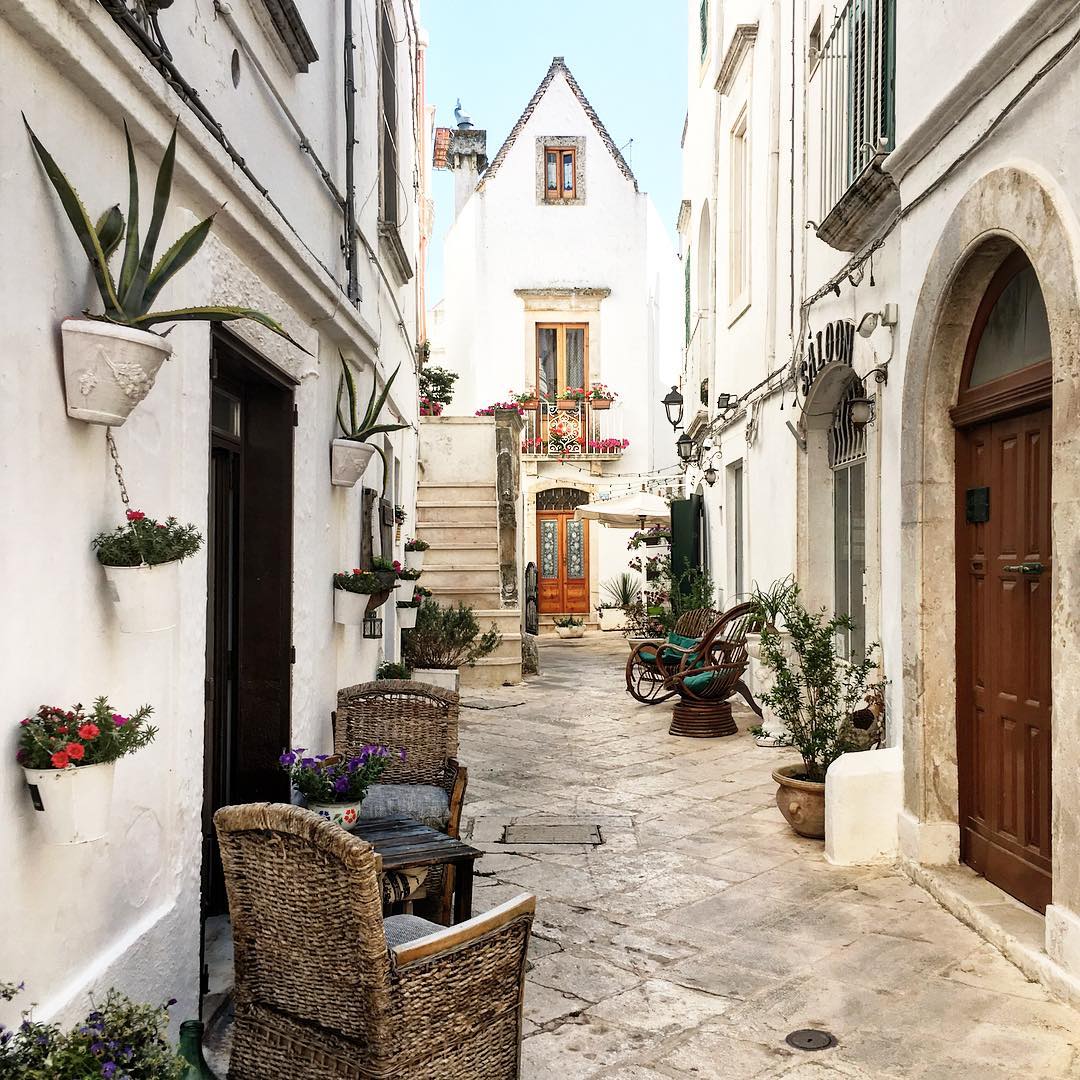
The Itria Valley stretches across the limestone plateau between Puglia’s Adriatic and Ionian coasts. Dry-stone walls, vineyards, olive groves and winding country roads shape a landscape that is easy to explore over a long weekend.
Four towns make a particularly good introduction to the area. Each has a distinct character, so the pleasure lies less in choosing a favourite than in seeing how different they feel from one another.
Alberobello and its trulli
Trulli appear throughout the Itria Valley, but Alberobello has the greatest concentration. These dry-stone buildings, with their recognisable conical roofs, are the reason the town became a UNESCO World Heritage Site in 1996.
Rione Monti is the busiest district, where many trulli now house small shops, cafés and restaurants. Aia Piccola is quieter and offers a more residential view of the town. Visit early if you want time to notice the painted symbols, stonework and narrow lanes before the streets fill up.
Locorotondo
Locorotondo occupies a hilltop close to Alberobello, yet its atmosphere is noticeably calmer. Its whitewashed historic centre follows a circular plan, reflected in the town’s name, and opens onto views across the valley from the public gardens.
Look out for the cummerse: local houses with steep, stone-covered roofs that give the skyline its distinctive rhythm. In summer, colourful balconies soften the white façades and make an unhurried walk through the centre especially rewarding.
Cisternino
Cisternino is compact and easy to explore on foot. White walls, external staircases and flower-filled lanes lead towards Piazza Vittorio Emanuele II and its clock tower, close to the Church of San Nicola.
The centre feels lived-in rather than staged. Allow time to wander without a fixed route, stopping in the small squares and looking through the archways that connect its streets.
Ostuni
Ostuni rises above the surrounding countryside in a dense cluster of white buildings. The cathedral stands at the highest point of the old town, while a network of lanes, staircases, restaurants and small shops unfolds within the former walls.
Its whitewashed façades are now the city’s visual signature. Rather than trying to follow a strict itinerary, start near the cathedral and descend through the historic centre, where sudden openings reveal views towards the coast and olive groves.
Staying in Ostuni
During our visit, we spent two nights at Relais La Sommità, a small property in the historic centre. Our room looked out towards the sea, and the hotel provided a bed for our dog, Charlie. The position made it easy to explore Ostuni on foot and return to a quiet space between walks.
Breakfast and lunch were served with views over the whitewashed roofs and lanes. Seasonal dishes, local wines and the restrained setting made food an important part of the stay without taking attention away from the city itself.
You can find current details on the official La Sommità website.
Planning a weekend in the Itria Valley
The four towns work well together because they are visually connected but never repetitive. Alberobello introduces the trulli; Locorotondo opens onto the countryside; Cisternino rewards slow wandering; and Ostuni combines architecture, food and broad views.
Travelling by car gives you the flexibility to stop along the country roads and explore beyond the main centres. Two or three days are enough for a first visit, though the valley easily justifies a slower return.