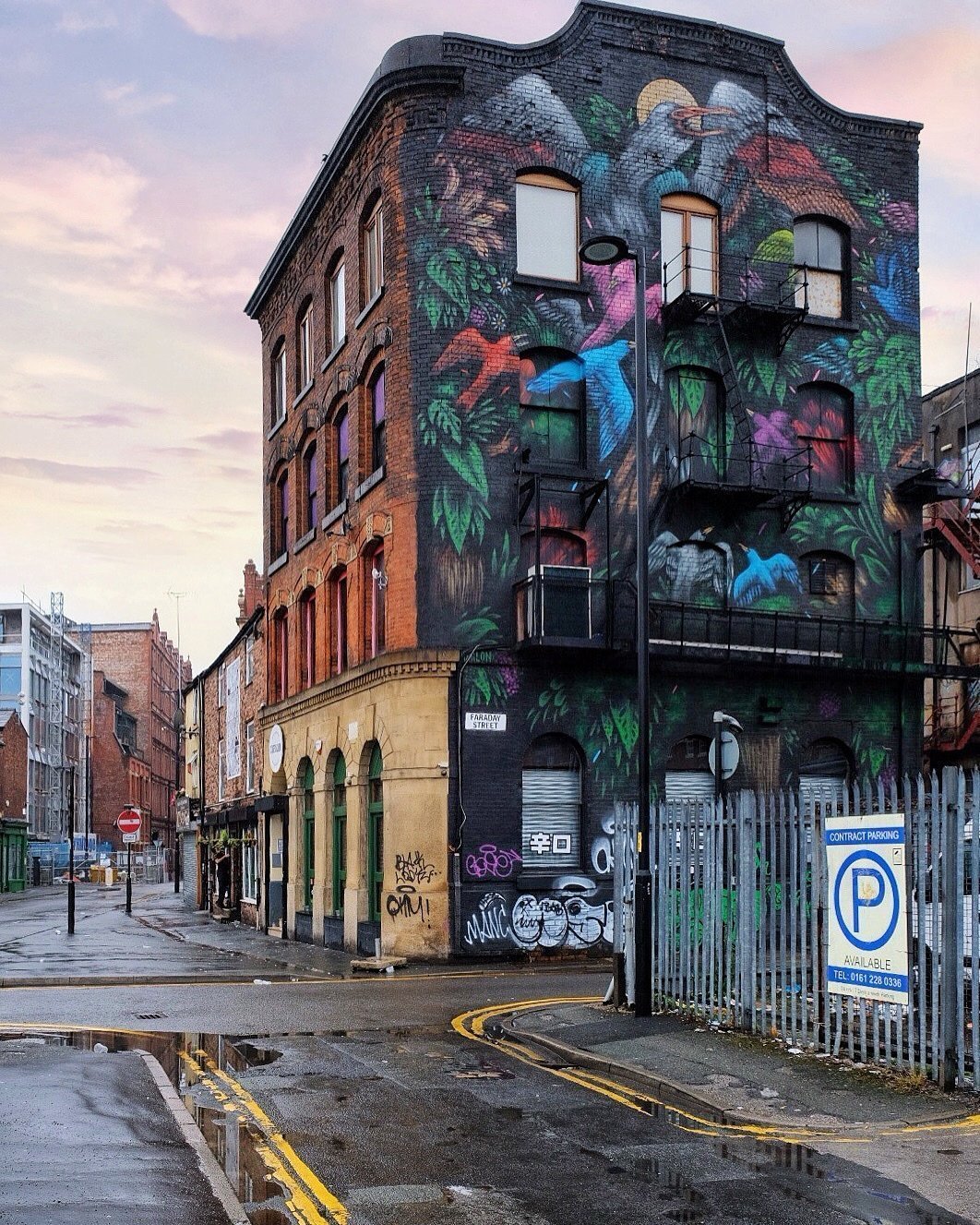
Manchester works well for a short city break. I visited with Visit Manchester and found a city whose industrial fabric now supports cultural spaces, restaurants, music venues and distinctly different neighbourhoods.
The worker bee appears throughout Manchester on mosaics, signs and civic symbols. It refers to the city’s history of industry and collective labour and remains one of the clearest details to notice while walking.
Places to include
The Northern Quarter is shaped by red-brick warehouses, murals, independent shops, record stores and cafés. Its back streets have often been used as film locations because they can resemble parts of New York.
The John Rylands Library looks almost ecclesiastical, with Gothic Revival stonework and a dramatic reading room. King Street and Barton Arcade offer further examples of nineteenth-century commercial architecture.
For food, Mackie Mayor occupies a former Victorian market and brings several independent kitchens into a shared hall. 20 Stories, in Spinningfields, offers a rooftop perspective over the city. The Peveril of the Peak is a compact historic pub whose tiled exterior stands apart from the surrounding buildings.
Football was part of the itinerary too, with a visit to Old Trafford. Even without attending a match, the stadium illustrates the scale of the sport’s place in Manchester.
I stayed at The Lowry Hotel near the River Irwell, between Manchester and Salford. Its position made both the centre and the regenerated waterfront areas straightforward to reach.
The trip was organised in collaboration with Visit Manchester and the stay was hosted by The Lowry Hotel. The account and opinions remain my own.