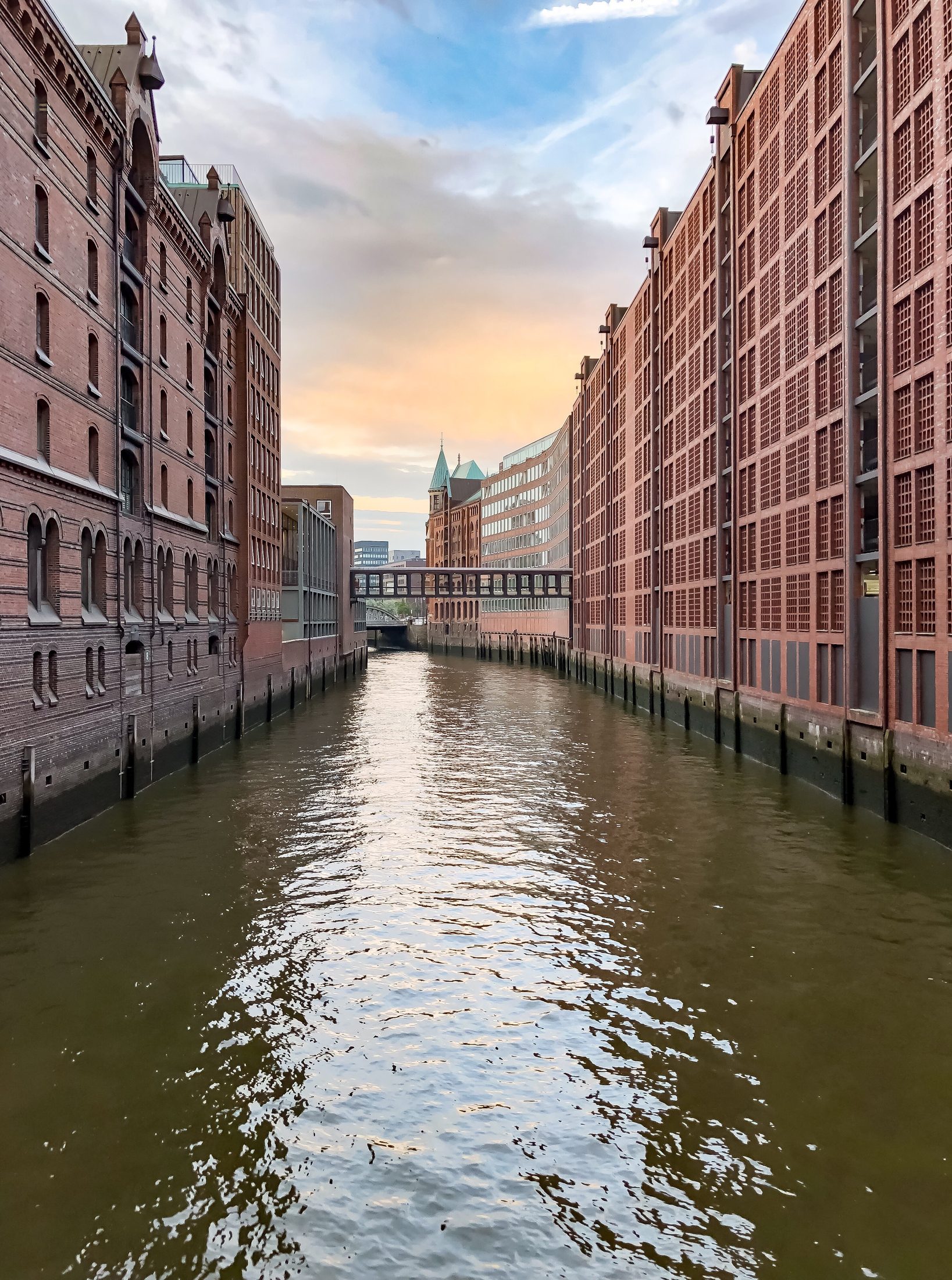
Hamburg is Germany’s second-largest city and one of Europe’s principal ports. Water provides its clearest structure: the Elbe, Alster lakes, canals and bridges connect historic warehouses with contemporary neighbourhoods and redeveloped waterfronts.
Speicherstadt and the harbour
Speicherstadt is the vast red-brick warehouse district between the centre and HafenCity. Bridges cross narrow canals between buildings originally raised on timber foundations. Walking reveals the façades at street level; a harbour boat offers a different view when the tide allows access.
The Old Elbe Tunnel opened to connect the northern harbour with the docks on the opposite bank. It can still be crossed on foot and leads to a broad view back towards the city and Elbphilharmonie.
Built above a former warehouse, Elbphilharmonie combines concert halls, a hotel and residences beneath its glass roofline. The public plaza is useful even without a concert ticket, offering a high circuit around the building.
St Pauli is associated with the Reeperbahn, football and nightlife, but the surrounding streets also retain traces of Hamburg’s maritime history through theatres, music venues and harbour businesses.
Staying at SIDE Design Hotel
I stayed at SIDE Design Hotel in the centre. Matteo Thun’s interiors favour simple forms, stone and glass, while a tall atrium and changing light installation provide the building’s focal point.
The hotel includes a spa and the [m]eatery restaurant, whose menu focuses on dry-aged meat alongside burgers, tartare and seafood. Its central position made the main sights manageable within 48 hours.
I reached Hamburg by train using an Interrail pass.
The stay was hosted by SIDE Design Hotel and rail travel was supported by Interrail. The account and opinions remain my own.