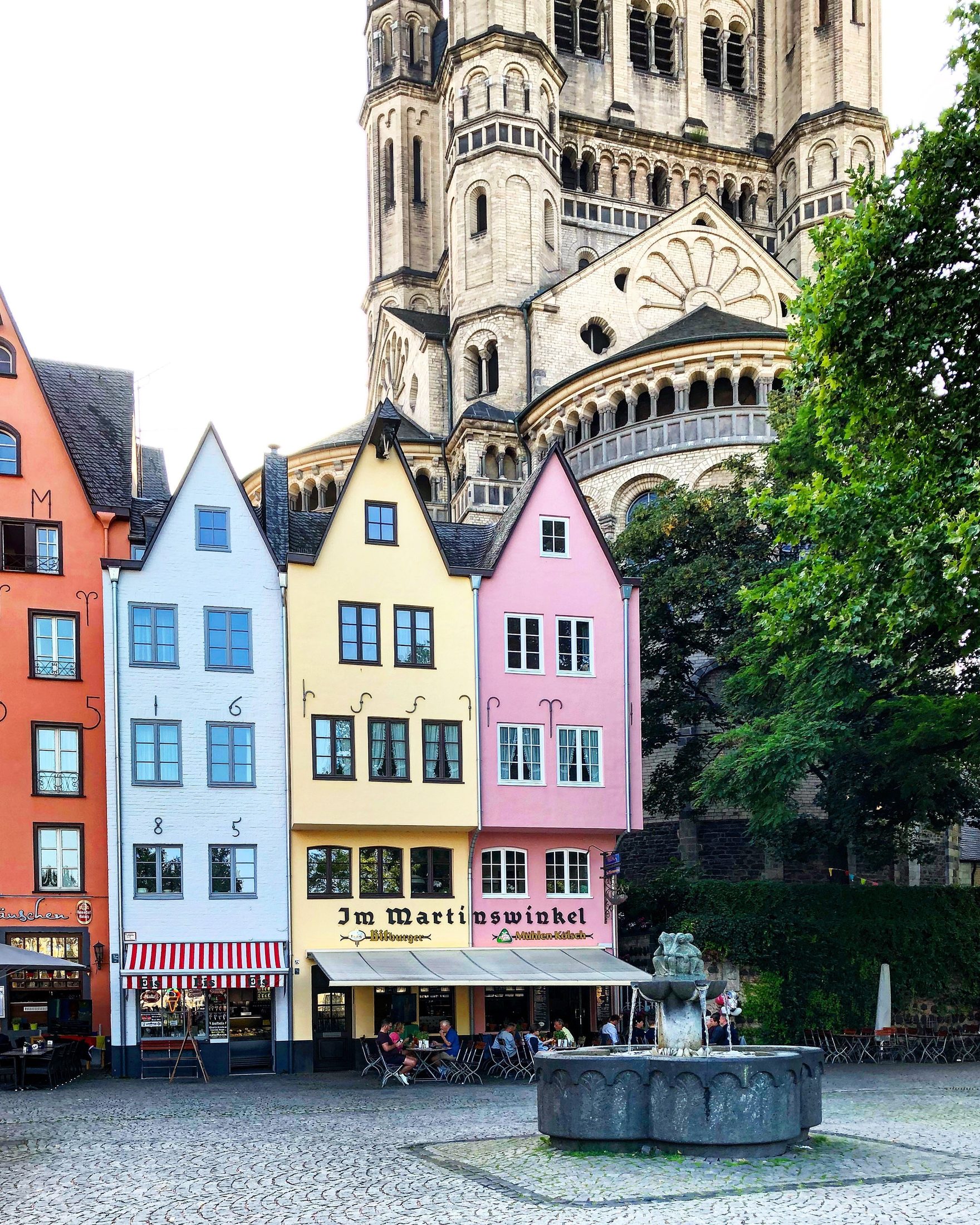
Cologne
Cologne’s centre was extensively rebuilt after the Second World War, yet the Rhine, cathedral and surviving historic streets still provide a clear structure for a short visit.
The cathedral rises immediately beside the main railway station and remains visible from many parts of the city. Crossing Hohenzollern Bridge on foot gives one of the best views back towards the twin towers, the old town and the riverfront.
Along the Rhine, narrow façades and stepped roofs introduce the historic centre. Traditional breweries serve Kölsch in small cylindrical glasses, while Museum Ludwig and the city’s many galleries show Cologne’s importance as a centre for modern and contemporary art.
Münster
Münster has a calmer scale and a centre shaped by more than a thousand years of history. St Paul’s Cathedral and the historic Town Hall are the principal landmarks, while Prinzipalmarkt is defined by arcades and tall gabled façades.
Aasee lies just beyond the centre and provides a straightforward walk through parkland beside the water. The combination of bicycles, university life and compact streets makes Münster easy to explore without a car.
We connected the two cities by public transport and kept the itinerary deliberately simple. In 48 hours, choosing a few central places in each city works better than trying to cover every museum and neighbourhood.