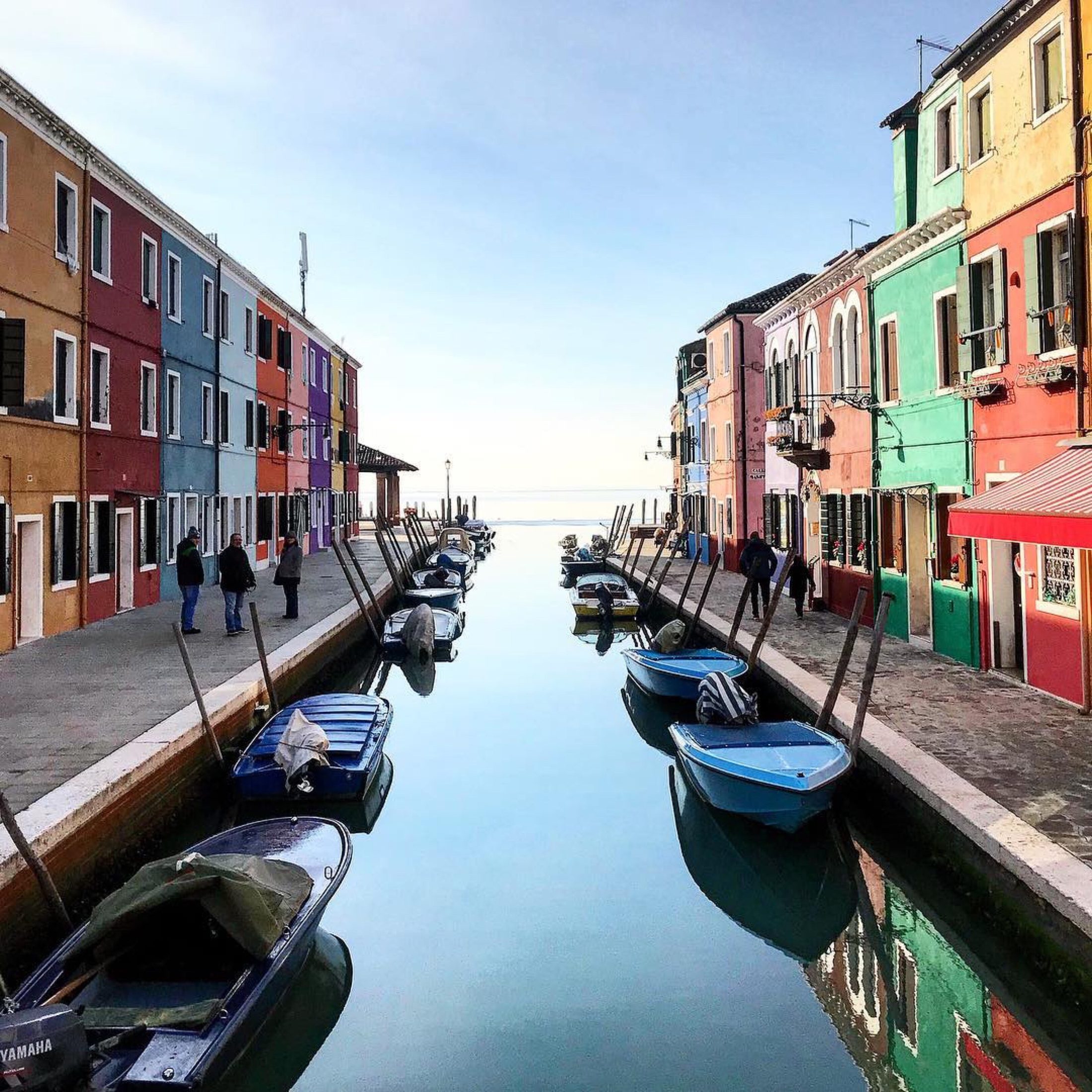
Burano is known for two things: its lace-making tradition and its rows of brightly painted houses. Reached by vaporetto from Venice, the island offers a compact network of canals and streets that can be explored comfortably on foot.
Colour is not simply decorative here. The façades follow a regulated system, and residents who want to repaint a house must request approval for the permitted shade. The result is a palette that changes from one group of buildings to the next without becoming completely random.
Lace-making is the island’s other defining craft. The former lace school now houses the Museo del Merletto, where the history and techniques of Burano lace are documented.
What to see in Burano
Piazza Galuppi is the island’s main public space, lined with restaurants, shops and civic buildings. Nearby, the bell tower of San Martino leans visibly from several viewpoints and acts as an easy reference while walking.
Tre Ponti is one of the most photographed spots. The wooden bridge joins three canals and opens onto several rows of coloured houses. It becomes particularly busy during the middle of the day, so early morning or the blue hour offers calmer conditions and softer light.
The old fish market, known as Pescaria Vecia, is another pleasant place to pause. From the stone tables and waterfront edge, the view extends across the lagoon and away from the busiest streets.
There is no single best season for Burano. Summer brings stronger light and larger crowds; cooler months reveal a quieter island and different colours. Whichever period you choose, allowing the day visitors to leave is often the simplest way to see a more relaxed side of the island.