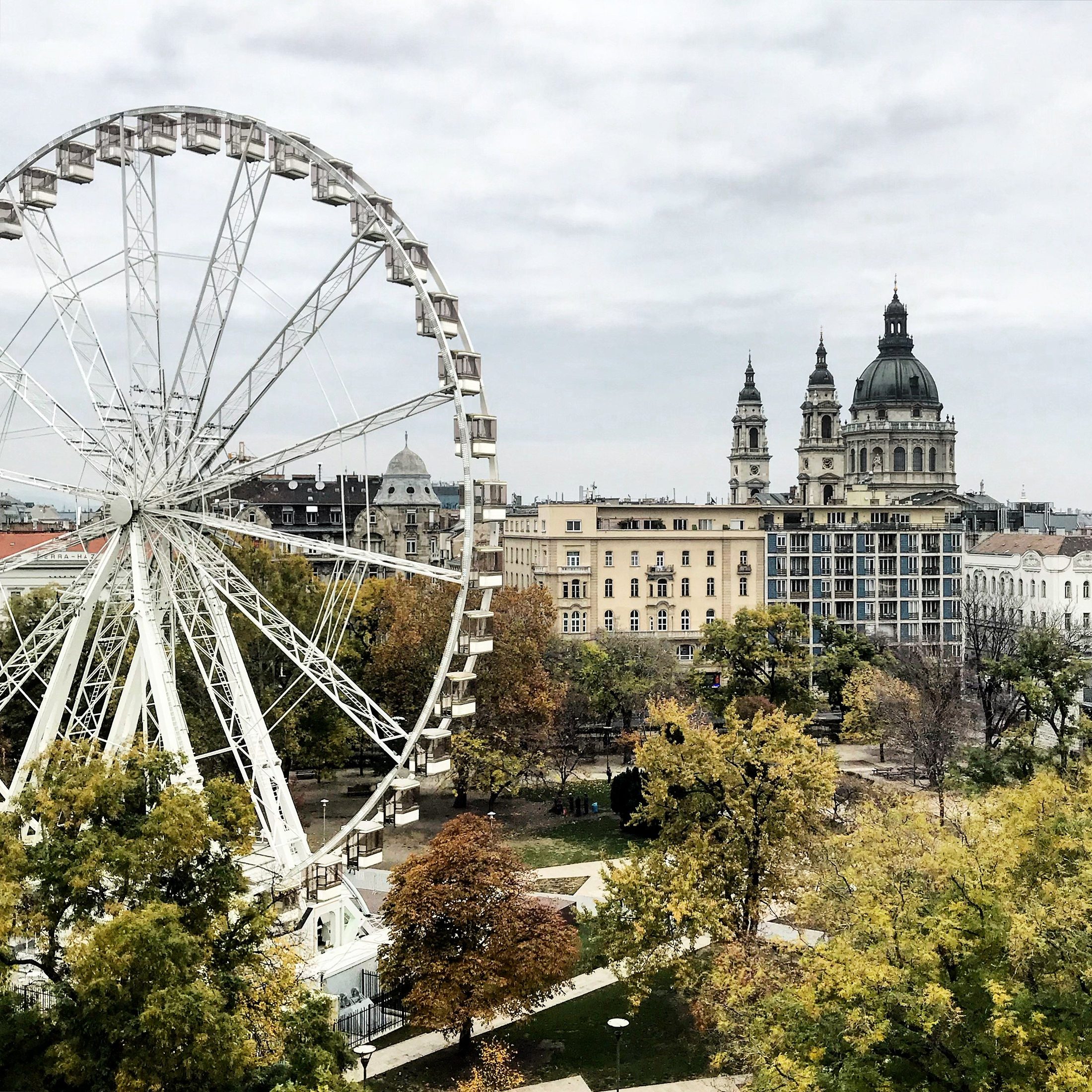
Budapest was not a city I had been planning to visit, yet it quickly overturned my expectations. We arrived to cold weather and low mist over the Danube; by the time we reached the centre, the river, bridges and illuminated façades had transformed that grey first impression into something far more compelling.
Our trip was connected to a collaboration with Kempinski Hotel Corvinus, but the city remained the focus of the two days. St Stephen’s Basilica was close to the hotel, and from there a short walk led directly to the river.
Budapest took its present form in 1873 through the unification of Buda, Pest and Óbuda. The Danube still provides the clearest way to read the city: hilly Buda rises on the western bank, while flatter, busier Pest occupies the eastern side.
Buda
Castle Hill is best explored on foot. Buda Castle, Matthias Church and Fisherman’s Bastion sit within a compact historic district, connected by narrow streets and broad terraces. From Fisherman’s Bastion, the view crosses the Danube towards Parliament and the rooftops of Pest.
The architecture gives Buda a quieter, more monumental character than the opposite bank. It is worth arriving early, before the most popular terraces become crowded, and leaving enough time to walk rather than move directly between landmarks.
Pest
Pest is flatter and easier to cover by metro, tram and bus. Shops, cafés, restaurants and much of the city’s nightlife are concentrated here, alongside major civic buildings and museums.
The Hungarian Parliament stands beside the Danube, while Heroes’ Square and the House of Terror introduce very different chapters of the city’s history. The Széchenyi Thermal Bath offers a change of pace, particularly after a cold day outdoors.
We also visited the Great Market Hall, whose stalls combine fresh produce, food counters and souvenirs beneath an impressive iron structure. In the Jewish Quarter, street art, synagogues and a dense mix of bars and restaurants shape a more contemporary side of Pest. We ate at Mazel Tov, a spacious restaurant set in a planted courtyard.
Staying at Kempinski Hotel Corvinus
Kempinski Hotel Corvinus has a central position close to Deák Ferenc tér, making both sides of the city easy to reach. We stayed in a spacious contemporary room on an upper floor, with views across the surrounding streets and square.
The spa includes an indoor pool, saunas, a steam room, treatment rooms and a fitness area. Breakfast was served at ÉS Bisztró, with a broad buffet and Hungarian options alongside familiar international dishes.
The hotel also brings together several distinct food and drink venues. ÉS Deli is useful for coffee, pastries and food to take away; Blue Fox The Bar focuses on cocktails; and Nobu serves its established combination of Japanese techniques and South American influences.
Two days were enough for an introduction, but not for a complete picture of Budapest. The contrast between Buda and Pest is precisely what makes a return worthwhile: one side offers elevation and historic views, the other the movement and everyday energy of the capital.
The stay was hosted by Kempinski Hotel Corvinus. The account and opinions remain my own.