The Alsace region
Alsace lies in eastern France, close to both Germany and Switzerland. Its position is reflected in the region’s architecture, food and place names: timber-framed houses line the streets of historic centres, vineyards rise behind small towns, and French and German influences sit naturally alongside one another.
The most useful way to explore the region is to combine Strasbourg and Colmar with a handful of smaller places along the wine route. Our itinerary also included Mulhouse, Eguisheim, Riquewihr and Kaysersberg. Each has its own scale and character, so the route never feels like a repetition of the same postcard.
Strasbourg
Strasbourg’s historic centre is best discovered on foot. Grande Île and Petite France bring together cobbled streets, canals and rows of timber-framed buildings, while the city’s role as a European capital gives it a markedly international atmosphere.
Petite France is the most immediately photogenic quarter. Its waterways, locks and former tanners’ houses form a compact district that rewards an unhurried walk. The Barrage Vauban is another worthwhile stop: from its terrace, the view opens across the water towards the old town.
Beyond these familiar landmarks, Strasbourg has enough churches, museums and neighbourhood streets to fill several days. It is worth leaving time for the city rather than treating it only as the starting point of a wider Alsace itinerary.
Colmar
Colmar’s old town is a sequence of narrow streets, brightly painted façades and flower-filled canals. The historic buildings are remarkably well preserved, but the city is more than a decorative backdrop: early mornings and quieter side streets reveal a gentler, more lived-in rhythm.
Mulhouse
Mulhouse offers a different perspective on Alsace. Its industrial past is visible in the city’s museums and architecture, while the old centre introduces a more colourful and compact side of the city. The contrast makes it an interesting addition to an itinerary otherwise centred on medieval towns and vineyard villages.
Eguisheim
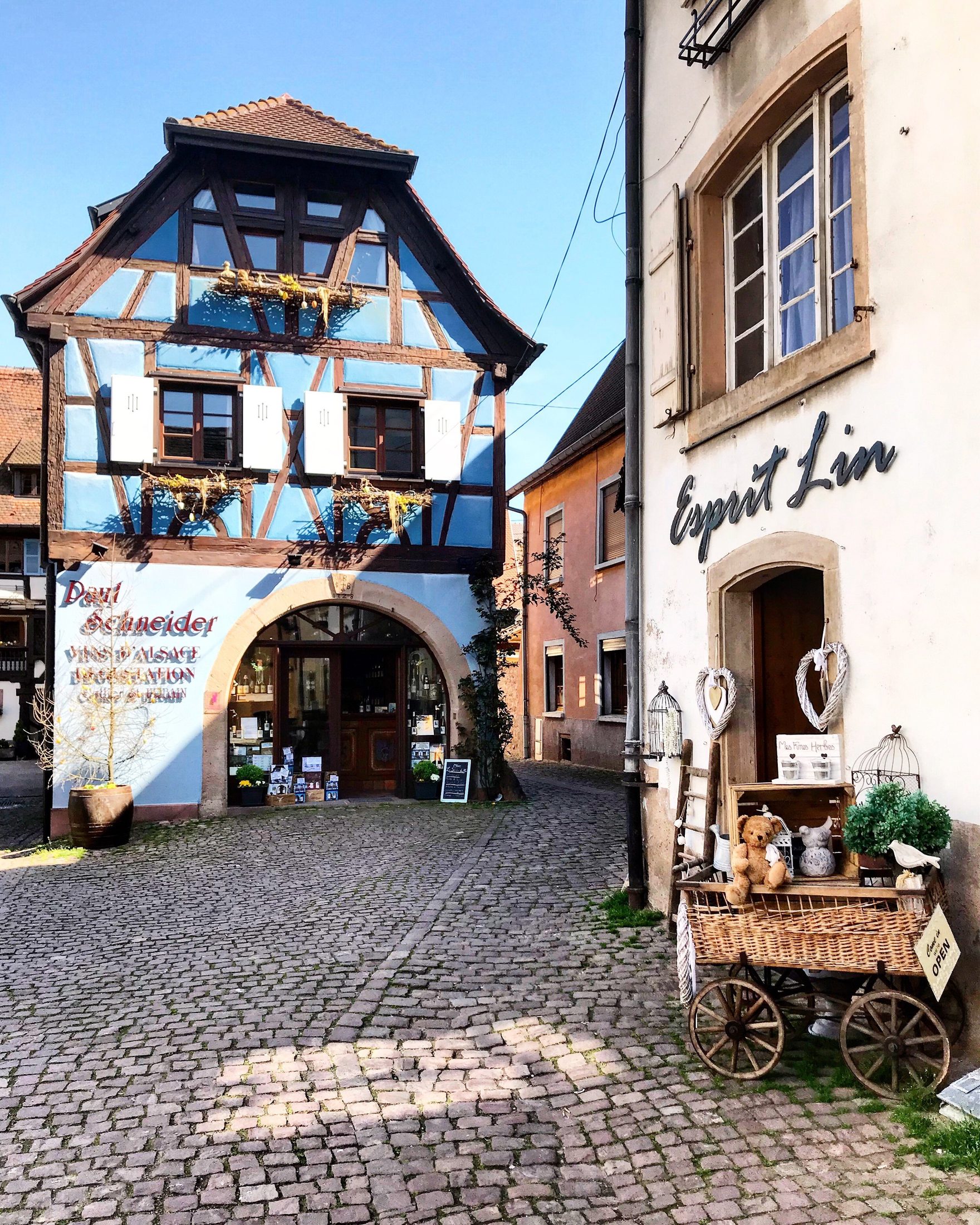
Eguisheim sits close to Colmar but has a distinct identity. Its circular lanes are lined with traditional houses in vivid colours, small fountains and abundant flowers. Storks nest above the rooftops, a sight closely associated with Alsace and still carefully protected across the region.
Riquewihr
Surrounded by vineyards, Riquewihr is a natural stop along the Alsace wine route. Ramparts enclose a centre of narrow streets and well-preserved houses, with the landscape never far beyond the old walls. Arriving earlier or later in the day makes it easier to appreciate the details without the busiest crowds.
Kaysersberg
Kaysersberg lies between Riquewihr and Colmar, in a valley framed by vineyards and wooded hills. A river runs through the centre, passing painted houses and historic buildings before the streets rise towards the remains of the castle. It is a fitting final stop: compact enough for a slow walk, yet closely connected to the wider landscape of Alsace.