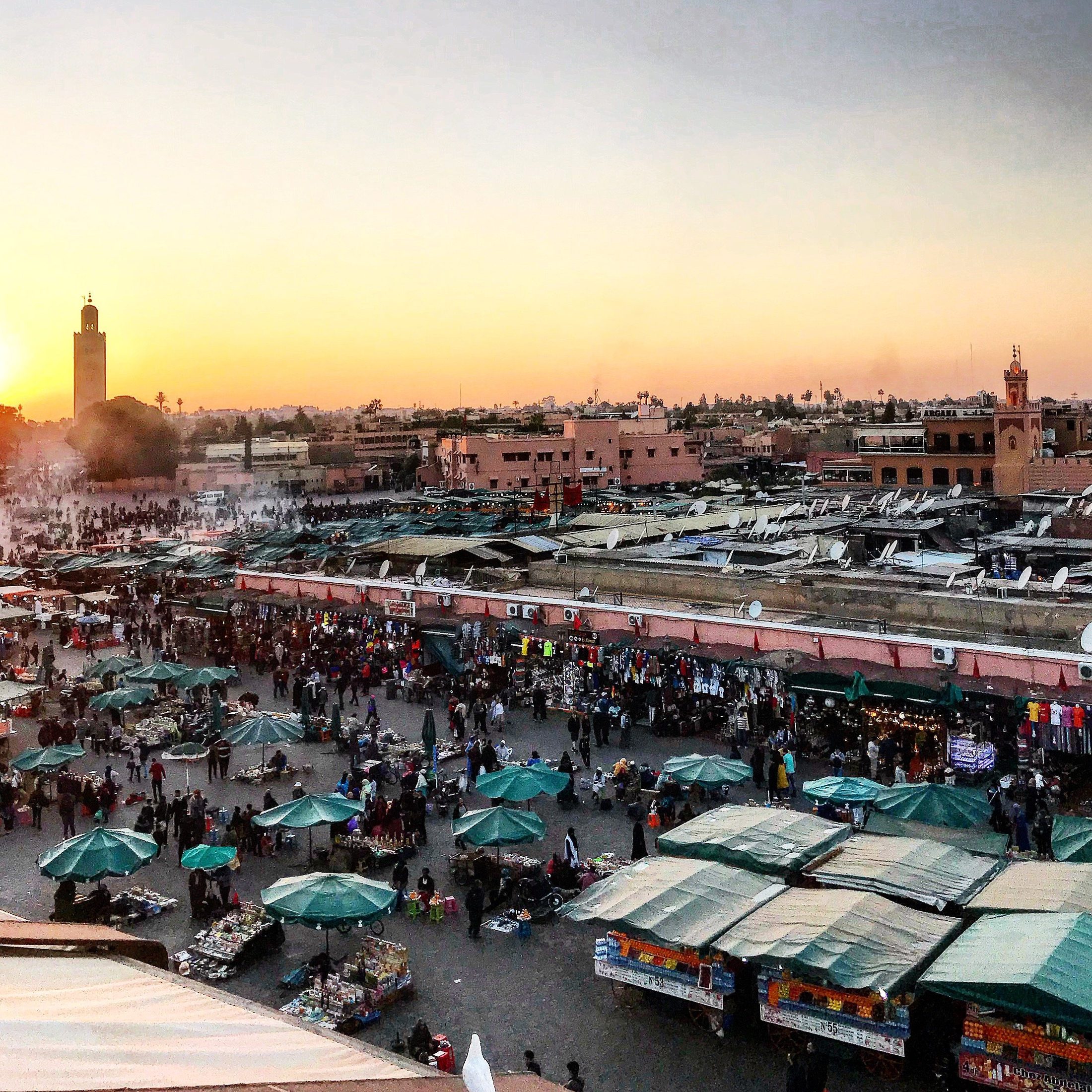
Marrakech - Morocco city
Marrakech is no doubt the most exotic and enchanting city close to Europe. Just landed, the thing that strikes you immediately is the airport. In fact, it’s considered one of the most beautiful airport in the World with its high windows that allow for plenty of natural light. Once upon a time, this city was so important that it gave its name to Morocco.
In fact, its thousand-year history is rich and its Berber origin can be seen in the metropolis of Atlas tribes.
Marrakech was once the warehouse for goods (slaves, spices, salt, gold, ivory and even Morocco leather) brought by Saharan caravan from the ancient African empires from Timbuktu. All of these created the city’s souks and its traditional way of life.
Even today this African nomadic influence is seen in the crowds and confusion of the Jemaa el Fna.
As in the past there were slave-traders, fortune-hunters, colonialists, sultans and princesses, nowadays Marrakech attracts movie stars, writers, artists and unconventional tourists.
As someone of you probably already knows, Marrakech is also called the “Red City”. Why? It won’t take you long to see. The natural red ochre pigment that embellishes its wall and facades look like dominant. Anyway, Marrakech has lots of other colors in the buildings too.
Like all Moroccan towns, this city is divided into the Medina (the old town) and Guéliz (the Ville Nouvelle or new town).
Anyway, each has its own charms: the Medina with its ancient buildings and riads, its winding souks and the main square of the Jemaa el Fna, and Gueliz with its cafés, trendy boutiques, gardens and boulevards. Therefore it became also a modern city, with nightlife and cultural events.
Highlights of Old Marrakech
Jemaa el Fna is the cultural heart of Marrakech. In this circle open area it’s easy to find Berber musicians and dancers, food stalls, medicine men, fire-eaters, sword-swallowers, acrobats, snake-charmers, henna tattooists and storytellers. Performers lead their monkeys and lizards past stalls selling orange juice, roasted chick peas, peanuts, sweet fritters, kebabs and tajines. When you need to take a rest from this madness, many cafés bordering the square have rooftop terraces offering a quite outstanding view.
Just west of the Jemaa el Fna is the Koutoubia Minaret. It’s the tallest feature on the medina skyline and its silhoulette is particularly beautiful at sunset.
On the otherside of the square, you can find the souks.
The souks of Marrakech are the largest in Morocco. They are so famous because it’s one of the most exotic places in the world to shop (and it’s quite unique).
Historically, all souks were divided according to the things being made and sold.
Today, little has changed. Each souk is still named after the product being sold.
The souks thread north from Jemaa el Fna and continue in a winding labyrinth until they hit the Musée de Marrakech.
The best time to visit it is in the cool of morning, or in the evening when the sunlight comes through roof shades, illuminating all the stuffs.
A beautiful spot to visit is le Jardin Secret.
This is a peaceful oasis, perfect for finding some peace and quietness after having strolled in chaotic Marrakech alleys. In fact, it’s an important place for history, for its garden and the architecture. We took the opportunity to go up in the tower and we ate some delicious food in the restaurant. I surely recommend it!
Highlights of New Marrakech
One of the most visited sites in the new part of Marrakech is le Jardin Majorelle.
The French painter Jacques Majorelle (1886-1962) created this enchanting garden in forty years of passion and dedication. The intense blue color is so dominant.
Mystic trees and exotic plants of dreamy origin, pools, water lilies and lotus flowers. All of these offer a calming retreat near the bustling old city of Marrakech.
Another point of interest is le Jardin Menara.
The name “menara” derives from the pavilion with its small green pyramid roof and it means lighthouse. Even if there is no real lighthouse in the gardens, any building that is at a high altitude is locally known as menara.
The pavilion and the pond (an artificial lake) are surrounded by orchards and olive groves. The intention of the basin was to irrigate the surrounding gardens using a sophisticated system of underground canals called a qanat. The water is carried from mountains located about 30 km from Marrakech. Also in here, you can rest a little bit in a calm place.
The food and the beverages
One of the great cuisines of the world, Moroccan cooking abounds with subtle spices and intriguing flavour combinations. Influenced by Andalusian Spain, Arabia and France, Morocco’s cuisine is a delicious combination of mouthwatering flavours that make it unique.
You cannot leave Marocco without trying Kefta Tagine, Couscous, Makouda, Zaalouk and others.
Beef or lamb mince with garlic rolled into balls and cooked in a tomato and onion sauce: this is Kefta Tagine.
Instead, Couscous is a fine wheat pasta traditionally rolled by hand. It is steamed over a stew of meat and vegetables. The meat is covered by a pyramid of couscous although the vegetables are put on the sides and the sauce served separately.
Makouda are little deep-fried potato balls, delicious dipped into spicy sauce.
Zaalouk is a smoked aubergine dip, seasoned with garlic, paprika and cumin. It’s usually eaten with vegetable salads and bread.
Finally, the mint tea, also known as “Moroccan whisky”. It is usually sweetened with sugar chipped off a sugar cone. In the teapot there are spearmint and gunpowder tea. It is poured into a tea glass from a height to create a froth called the crown.
Riad Tawargit
Staying in a riad in the old medina of this city is a unique experience. The term “riad” means garden but it is applied to town houses built round a central courtyard with a fountain.
By the nature of their construction riads are very intimate spaces. The one in which me and my girlfriend stayed was very chic and charming.
The Riad Tawargit is ideally located in a calm and safe neighbourhood in the Old Medina. It’s very near to the Souks, Jemaa el Fna Square and other mythical places of Marrakech.
This elegant 380 meters square guest house combines perfectly contemporary and Moroccan style.
Rooms, suites and services
On the ground level, there are different chill out areas with a jacuzzi, a library, a steam room and fireplaces.
There are 5 rooms and 4 suites, therefore this place can guest not so many people and cannot be crowded. This is why I love this riad!
It’s a peaceful oasis in the heart of a bustling Marrakech.
On the private rooftop you can sunbath, relax and enjoy the amazing view of the city.
We stayed in suite number 9, located directly on rooftop and it was very quiet because it has its own private terrace. Each room has its own particular style and tone: this is in elegant ecru and white.
The breakfast is served on the ground floor and it has a large possibility of choices. Yogurt, cakes, biscuits, home made bread, local jam, fresh fruits, crepes, butter and cheese. Everything accompanied by tea, coffee and fresh orange juice. The staff is very attentive to every desire or request but not intrusive. Each one is very kind and friendly.
They also took care of our airport transfer and they can organize day trip, guided tours and other activities.
What’s more? On request, you can have lunch or dinner in the patios or in your private terrace in you are staying in a suite, in order to taste authentic moroccan specialities.
We really enjoyed the jacuzzi when we come back after strolling in the city center. You can also ask for some wine for chilling and this is quite unique in Marrakech.
In conclusion, I surely recommend this place and using the promo code “DAGNIEE” you will get 10 to 20% off.
So what are you waiting for? Book through the website www.riadtawargit.com.
